

19 Aug YouTube Is The New Powerhouse For Marketing To CISOs, MSSPs And SMBs
Cybersecurity Videos For SEO & GEO In The Age Of AI
 – Steve Morgan, Editor-in-Chief
Sausalito, Calif. – Sep. 1, 2026
As one of the world’s largest social media platforms with more than 2.7 billion monthly users, YouTube can help brands reach their audience at scale. But the platform offers more than visibility; it’s become one of the primary ways customers discover products and make purchasing decisions, according to Salesforce. This means it gives brands the chance to engage at every stage of the sales funnel. As such, YouTube marketing is now a must-have for brands that want to get discovered, build trust, and drive demand at scale.
Cybercrime Magazine CMO Report 2026
What’s Inside:
- Top B2B Focused Cybersecurity Channels
- YouTube For SEO & GEO In The Age Of AI
- YouTube Dominates AI Search
- Avoiding Classic YouTube Mistakes
- Cybercrime Magazine YouTube Channel
- Editorial-Style Videos
YouTube is a powerhouse for marketing because of its vast user base, high engagement rates with video content, and ability to boost brand awareness, drive traffic, and build trust through educational and engaging content, all while leveraging the power of Google’s search engine.
YouTube also functions as the world’s second-largest search engine (behind its parent). It allows businesses to build long-term trust, educate buyers, and capture high-intent prospects who are actively searching for product solutions. Video content also compounds in value over time, unlike fleeting social media posts.
“I want to watch the CISO Demo series on the Cybercrime Magazine YouTube Channel because it gives me lots of information about a specific vendor or capability or even risk that I’m trying to address in a single byte-size amount of time,” says Adam Keown, CISO at Fortune 500 company Eastman. “That helps me narrow down two or three vendors to talk to versus having to speak to the tens-of-thousands of cybersecurity vendors that are out there.”
Video builds immediate familiarity by letting audiences see faces, hear voices, and experience corporate culture. B2B offerings — such as cybersecurity software and solutions — are much easier to demonstrate using deep-dive b-roll and product walkthroughs.
AI models (like Gemini and ChatGPT) frequently cite and pull context from YouTube transcripts and metadata, making video an essential part of modern Generative Engine Optimization (GEO).
Top B2B focused cybersecurity channels
Out of the pure play cybersecurity b2b focused media outlets and event producers with YouTube channels listed by their number of subscribers (minimum of 1,000 subscribers), Cybercrime Magazine is far and away the top channel based on its number of subscribers (1.2 million), and views per video.
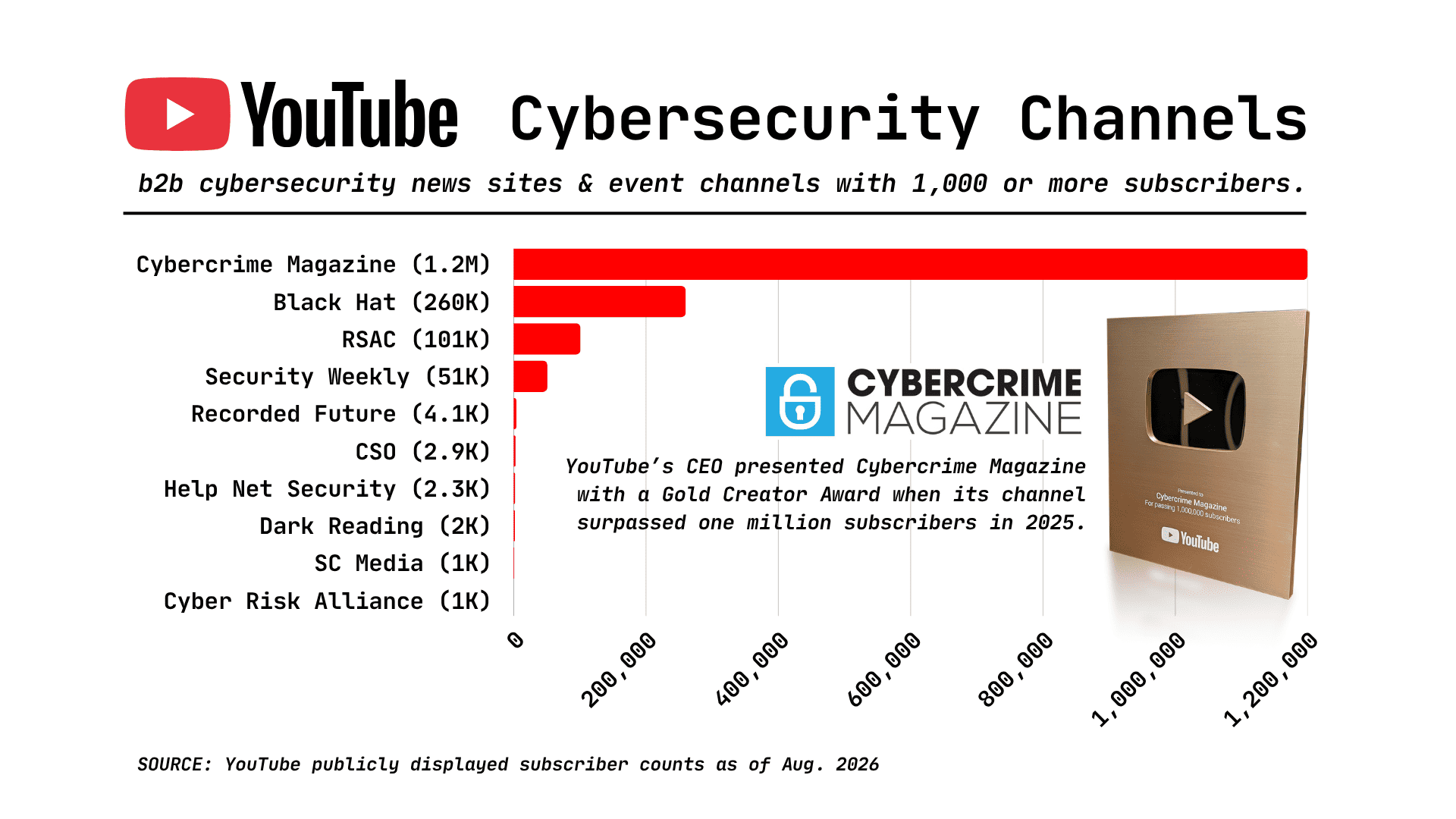
The editors at Cybercrime Magazine compiled the list by searching on all cybersecurity focused media outlets (b2b media / news sites and event producers) that they are aware of, and then looking up their channel for the publicly displayed subscriber counts reported by YouTube.
Many media outlets do not have a YouTube channel, or they had one previously but no longer produce videos there (or haven’t for a year or more), or they have less than 1,000 subscribers. Excluded from this list are solo / independent video producers (where a single person is the brand, and there is not a media outlet with its own audience) and channels that are focused mainly on consumers, training and education, entertainment, and other content that is not geared to CISOs and security leaders.
YouTube Is Mandatory For SEO & GEO In The Age Of AI
This section is a special contribution written by Greg Jarboe and originally published in Search Engine Land, a Semrush (an Adobe company) media property.
 As search shifts to AI-driven answers, YouTube is becoming key source material. Brands that underinvest in video risk losing visibility.
Getting found in all the right places has always meant being early to the next major shift in search.
Today, that shift is toward GEO, or generative engine optimization, and SEO redefined as search everywhere optimization.
Both describe the growing need to optimize content for AI-driven discovery.
If YouTube still sits in the “nice-to-have” category of your SEO strategy, you are quietly ceding visibility in both traditional rankings and Google AI Overviews to competitors.
YouTube is now core search infrastructure
YouTube can’t be relegated to “brand” or “social” anymore because the platform is now core search infrastructure.
YouTube is the second most‑visited website in the world, drawing roughly 51.7 billion visits per month (as of Jul. 2026), behind only Google.com itself.
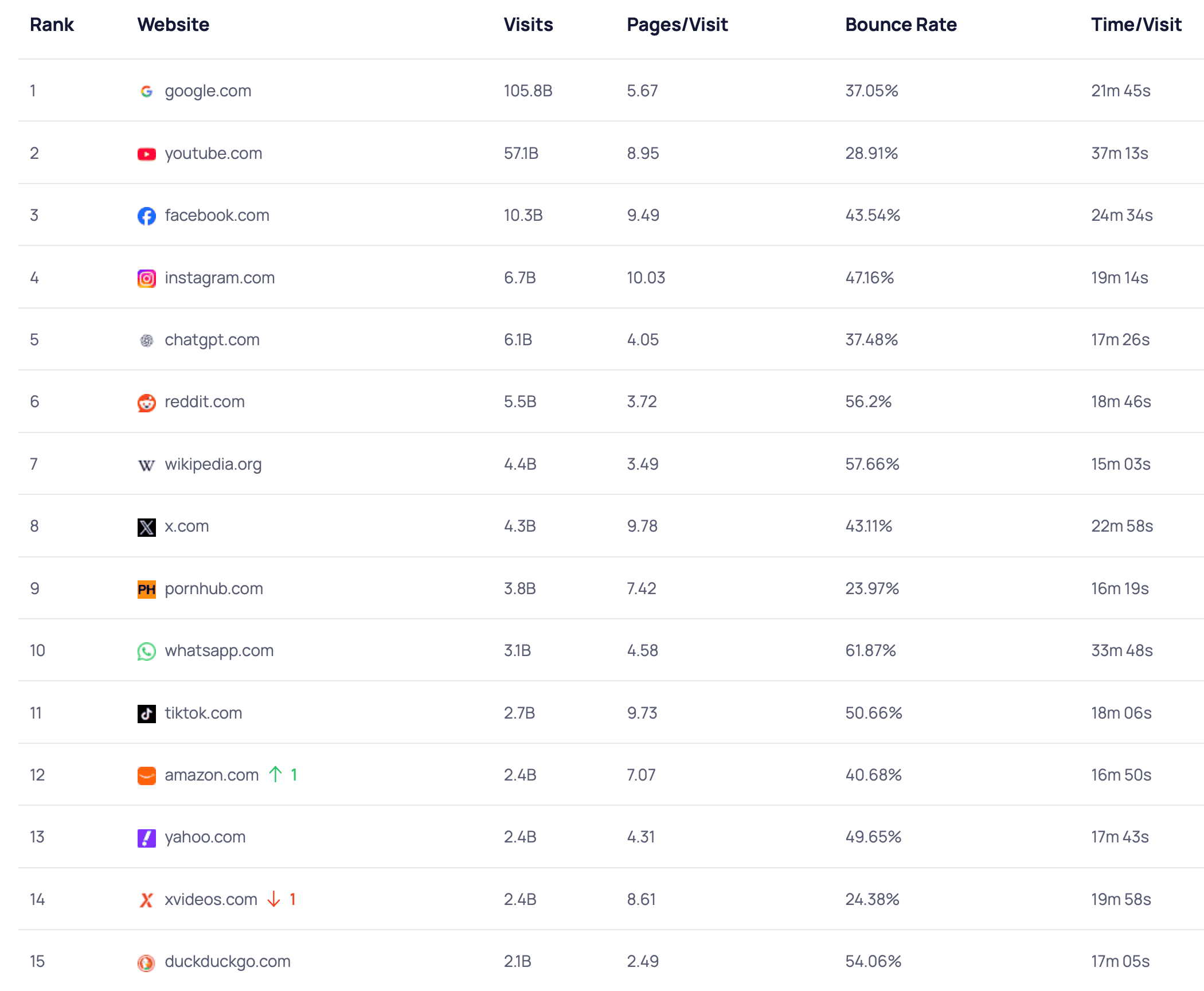
This is 5.4 times more visits than Facebook gets and 8.7 times more visits than ChatGPT gets.
That scale alone makes YouTube impossible to ignore as a search destination.
But reach is only part of the story.
In just two decades, YouTube has gone from grainy webcam uploads to fully fledged studios producing popular talk shows and feature‑length films, and that evolution has changed where and how people watch.
TV screens have now surpassed mobile and are the primary device for YouTube viewing in the U.S. by watch time.
Nielsen data shows YouTube has been number one in streaming watch time in the U.S. for two years.
For more and more viewers, “watching TV” effectively means “watching YouTube,” which turns the platform into a default, living‑room discovery surface for everything from entertainment to “how‑to” content.
This shift to the big screen has direct implications for search.
Viewers are watching over 1 billion hours of YouTube content on TVs every day, and that viewing now includes Shorts, podcasts, and live streams right alongside sports, sitcoms, and talk shows.
In other words, the “new television” behaves like an interactive, multimodal search interface.
Users bounce between long‑form videos, short clips, live commentary, and companion apps on their phones, all while sending strong engagement signals that recommendation systems and AI models can learn from.
YouTube’s connected TV growth is also reshaping the ad and commerce landscape that surrounds search.
New big-screen formats, including QR codes and pause ads, along with second-screen experiences that let viewers comment or shop from their phones, generate more measurable intent signals across devices.
Features such as “Watch With” let creators add live commentary and real-time reactions to major events, turning tentpole moments, including sports, into interactive search sessions for explanations, opinions, and highlights.
All of this feeds back into Google’s broader ecosystem.
YouTube videos now surface in Google’s main search results, featured snippets, Discover, Shorts modules, and – increasingly – as cited sources in Google AI Overviews.
When the same asset can win visibility on the living‑room TV, in YouTube search and recommendations, and inside AI‑generated answers on Google.com, it stops being a side channel and becomes a core SEO asset.
YouTube dominates AI search
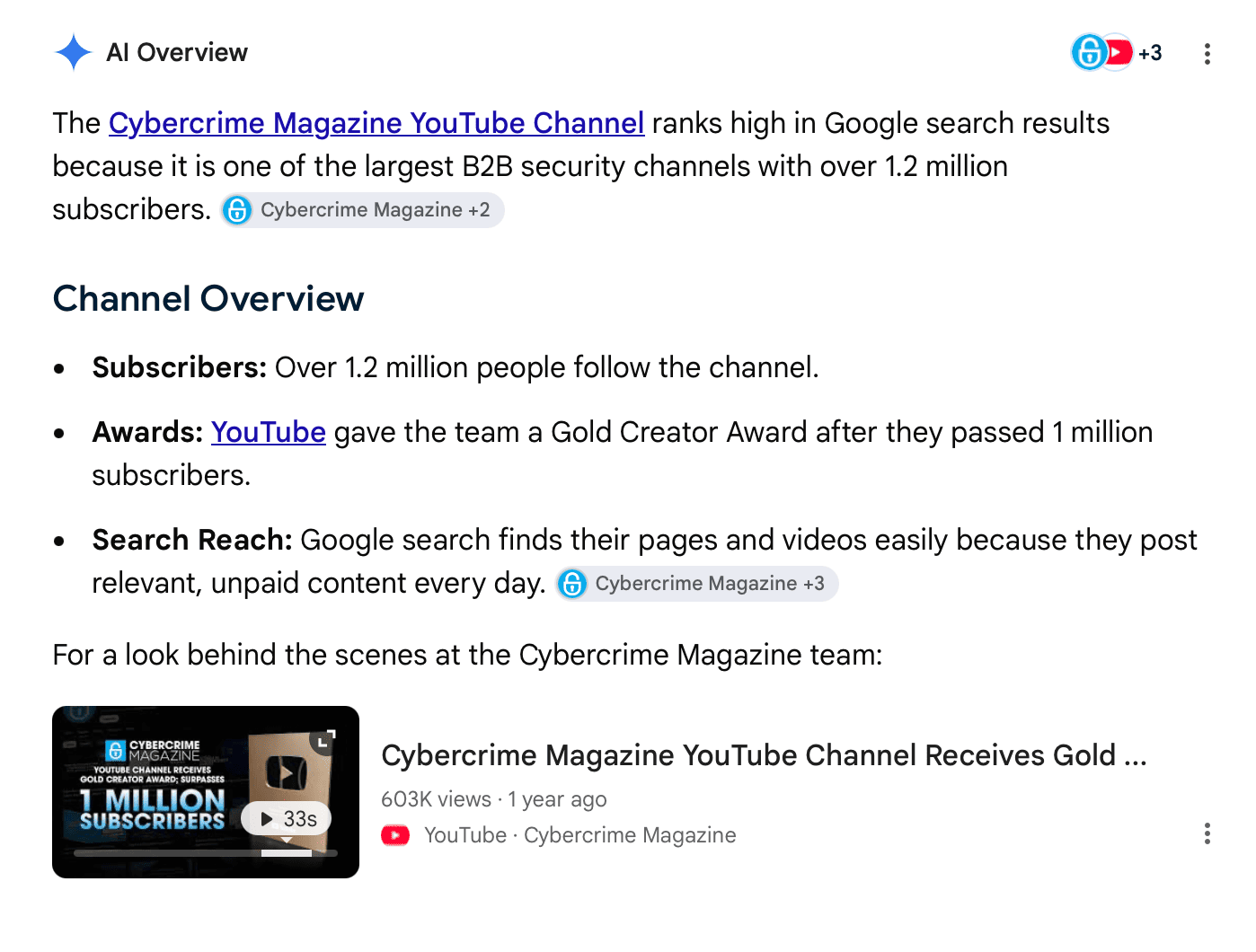
Up to 29.5 percent of Google AI Overviews cite YouTube, according to recent BrightEdge data, making it the top domain overall.
This gives YouTube a 200x advantage over its nearest direct competitor (Vimeo at 0.1 percent).
AI platforms like Perplexity and ChatGPT overwhelmingly cite YouTube, despite having no apparent incentive to do so.
The queries that YouTube videos are more likely to show up are for tutorials (finance, software, medical “how-to” content) as well as pricing, deal hunting, product demos, and reviews.
This means AI Overviews are not just summarizing webpages.
Searchers are leaning hard on videos that clarify complex tasks, show physical techniques, or provide visual proof.
If your YouTube catalog is thin, poorly structured, or misaligned with real queries, then your brand is less likely to be pulled into those machine-written answers.
YouTube at 20: A creator-first discovery engine
YouTube’s 20th anniversary in 2025 underscored a second, equally important shift: discovery is now dominated by creator-driven ecosystems, not traditional studio or brand content.
For the sixth year in a row, MrBeast topped the U.S. creator leaderboards, but the deeper signal is that attention accrues to channels that understand pacing, storytelling, and community, not just production values.
Gaming, entertainment, and music trends highlight how participatory culture drives discovery.
User-generated Roblox experiences like “Grow a Garden” and “Steal a Brainrot” outperformed many polished, professionally developed games.
Universes such as Squid Game and KPop Demon Hunters expanded because thousands of creators built skits, challenges, and commentary around them.
In music, Rosé and Bruno Mars’ “APT.” becoming the fastest K-pop video to a billion views shows how Shorts, remixes, and fan engagement can outpace legacy hits like “Gangnam Style.”
Why this culture shift matters for SEO
At first glance, Squid Game skits and Roblox challenges may feel distant from B2B SaaS or local services, but the underlying mechanics are exactly what AI-driven discovery rewards.
YouTube’s recommendation system, and by extension the content that surfaces in search and AI Overviews, favors episodic content, clear topical clustering, as well as formats that invite interaction and repeat viewing.
This means the old “upload a video, embed it on a landing page, and call it SEO” model no longer works.
You now need:
- Video series that build authority on a topic.
- Shorts that accelerate demand for those series.
- Collaborations that plug brands into existing creator ecosystems.
These are the same engagement and expertise signals AI systems lean on when deciding which sources to cite or summarize.
Inclusion is the new ranking
AI Overviews do not behave like a traditional 10-blue-links SERP.
They synthesize answers and then expose only a handful of underlying citations, which can include videos, not just pages.
In this environment, the SEO objective shifts from “rank position X for query Y” to “earn inclusion as a trusted source that the AI is willing to quote.”
For YouTube, that means metadata, structure, and on-screen language become training data.
Titles, descriptions, chapters, transcripts, and captions all shape what the model thinks a video is about and whether it deserves a mention in a synthesized answer.
Winning is less about clever tags and more about making each asset legible, rich, and credible to both humans and machines.
The 2026 YouTube SEO checklist
You can operationalize this “inclusion mindset” by adopting a YouTube SEO checklist built for AI-mediated discovery, not just video search rankings.
Four pillars drive that approach:
- Intent-driven metadata.
- Structural optimization.
- Authority signaling.
- Strategic integration.
Intent-driven metadata
First, rethink how titles and descriptions connect to actual search behavior.
Reframing titles as queries means moving away from branding-heavy phrasing (“Acme Cloud – Spring 2025 Platform Update”) toward language that mirrors user intent (“How to cut cloud storage costs 30 percent without sacrificing performance”).
This immediately increases relevance for both YouTube search and Google AI Overviews, which lean heavily on query–document alignment.
Descriptions should act as structured summaries written for both “machine readers” and people, clearly stating:
- Who the video is for.
- What problem it solves.
- Which key steps or concepts it covers.
On-screen language matters, too.
When presenters speak target keywords and concepts clearly, or reinforce them with text overlays, you give speech recognition and vision systems more reliable data to work with.
Structural optimization
Second, treat each video like a chaptered resource rather than a monolithic asset.
Timestamped chapters provide a roadmap of key moments that YouTube and Google can surface directly in results and AI Overviews, often linking to the exact point in the video that answers a question.
Accurate, uploaded transcripts reduce the noise created by auto-captions and ensure that nuanced terminology, product names, and step-by-step instructions are correctly captured.
Comprehensive captions serve accessibility and SEO at the same time.
They help users watch in sound-off environments and give crawlers richer text to analyze, reinforcing topical relevance, entities, and relationships that matter to ranking and citation systems.
Authority and topical clustering
Third, shift from sporadic uploads to topical clusters that build authority.
For instance, instead of publishing a single explainer on Core Web Vitals, consider building a series that covers measurement, prioritization frameworks, case studies, and implementation walkthroughs, all interconnected via playlists and end screens.
This mirrors the content cluster strategies many SEOs already use on the web, but in a video-first format that AI systems increasingly value.
Authority also comes from multimodal demonstrations.
Walkthroughs, live teardowns, interviews with subject-matter experts, and deep-dive commentary all signal expertise far more clearly than generic talking-head pieces.
A portfolio that mixes long-form, podcast-style episodes, shorter explainers, and live streams conveys both depth and breadth on a topic, which can increase the odds of being selected as a source when AI Overviews assemble an answer.
Strategic integration with Shorts and creators
Finally, integrate YouTube into a broader search strategy rather than treating it as an isolated channel.
Shorts can act as an acceleration layer, teasing key insights from long-form videos and driving viewers (and engagement signals) back to cornerstone content.
Aligning Shorts topics and hooks with the queries your SEO and PPC campaigns already target helps you surround high-value topics with multiple, complementary formats.
Creators should be seen as collaborators, not competitors.
Co-created content, guest appearances, and reaction formats can help your brand connect with existing fan bases and participatory cultures that already have momentum.
When AI systems scan the landscape for trusted voices on a topic, these networked relationships and repeated cross-mentions help reinforce your authority, much like high-quality backlinks do for traditional SEO.
Avoiding classic YouTube SEO mistakes
Many search teams still fall into patterns that made sense when video was only a supporting asset, but those habits now actively limit visibility.
Common mistakes include:
- Treating video titles as pure branding.
- Writing descriptions only for humans.
- Skipping chapters.
- Relying solely on auto-captions.
- Posting sporadically rather than building series.
Each of these choices removes a signal that AI systems could have used to understand, rank, and cite your content.
There is also a strategic blind spot: separating “YouTube strategy” from “SEO strategy” and letting different teams own each in isolation.
In an environment where AI Overviews are pulling from both webpages and videos, that silo hurts performance on both sides.
The brands that win are aligning keyword research, topic clustering, and measurement across web and video, then feeding those insights back into content roadmaps.
Redefining ‘all the right places’ in 2026
In 2026, getting found in all the right places includes:
- AI Overviews.
- Conversational interfaces.
- YouTube recommendations.
- Shorts feeds.
- Creator ecosystems.
- Podcast platforms.
YouTube is no longer a peripheral channel for awareness campaigns.
It is a structured, searchable, multimodal data source that feeds directly into Google’s most visible experiences.
Teams that treat their YouTube channels as core SEO assets — designed to be understood and trusted by both people and AI — will be the ones still getting found in all the right places as the next decade of search unfolds.
Cybercrime Magazine YouTube Channel
Many cybersecurity companies fail at building their own YouTube channel because they don’t have full-time staff dedicated to YouTube and/or video, and they don’t have a sufficient YouTube subscriber base and audience.
Cybercrime Magazine has invested heavily into a full-time staff working out of our HQ and studios, and we have the resources to implement the best practices that have led to the top b2b cybersecurity-focused YouTube channel.
A rising tide lifts all boats, and that is true of the Cybercrime Magazine YouTube Channel. That is as important as anything else in this report. All of the cybersecurity companies who are on our YouTube channel also benefit from each other and all of the subscribers and viewers who watch one video after the other.
“There are many times where it’s early in the morning or even late at night that I’m looking at cybersecurity vendors,” says Adam Keown, CISO at Fortune 500 company Eastman. “I’m reading articles. I am trying to find a demo on YouTube for them to give me a glimpse of what’s going on,” adds Keown, who has appeared as himself on the Cybercrime Magazine YouTube Channel, and trusts it as a reliable source for learning about new cybersecurity products, platforms, and services.
If you’re a cybersecurity CMO or company, then we invite you to get in touch with us and learn how we can produce and promote a video or series for your brand.
Editorial-style videos
An editorial style video uses journalistic narration and storytelling, changing scenes and angles, and b-roll, over plain, unedited or minimally edited footage that has no cuts, transitions, text, music, color correction, or special effects added. Presumably, a media outlet will have full-time content producers, video and sound engineers, and producers, in order to produce editorial style videos.
The Cybercrime Magazine YouTube Channel has produced several videos over the past year for Scott Schober, a well-known cybersecurity author, inventor, media personality, and entrepreneur, and CEO at Berkeley Varitronics Systems, manufacturers of wireless security, detection and testing solutions for law enforcement, government, and critical Infrastructure:
“We’ve had a successful experience working with Cybercrime Magazine on a series of two-minute videos they produced and developed for us,” says Schober, who has appeared as a cybersecurity expert on Bloomberg TV, CBS, CNBC, CNN, FOX, Good Morning America, Inside Edition, MSNBC, NPR, The Wall Street Journal, and numerous other broadcast TV and radio stations.
“The Cybercrime Magazine team has consistently delivered exceptional work across multiple video projects. Although we have in-house video production capabilities, we chose to partner with them because of their deep expertise in cybersecurity and their ability to communicate complex threats in a clear, compelling way.
“One particularly effective project highlighted the growing threat of credit card skimmers. Cybercrime Magazine created an independent, editorial-style video that not only captured the magnitude of the issue but also seamlessly integrated our detection solution into the narrative. What impressed me most was their responsiveness, attention to our goals, and ability to deliver a polished, professional video that resonated with our target audience.
“We regularly use these videos when engaging with prospects, as they offer an informative, non-promotional perspective that helps build trust and understanding. Their formula—professional narration, sharp editing, and integration with editorial coverage—has added tremendous value to our sales and marketing efforts.
“In a highly competitive cybersecurity market, their work has become a powerful asset to our overall branding and messaging strategy. I strongly recommend Cybercrime Magazine to any organization looking to produce impactful, high-quality video content.”
About
The award-winning Cybercrime Magazine YouTube Channel has more than 1.2 million subscribers. YouTube’s CEO presented us with a Gold Creator Award in 2025.
We have produced 500+ videos, including 60-second elevator pitches, 90-second product demos, 2-3 minute company profiles, 15-30 minute interviews and roundtables, 10-30 minute documentaries, as well as fireside chats and presentations at live venues.
Our channel features the largest cybersecurity companies, hottest VC funded startups, iconic founders and CEOs from our industry, Fortune 500 and Global 2000 CISOs, celebrities, famous hackers, media personalities, women in cybersecurity, authors, inventors, industry analysts and experts, ex-cybercriminals, and government cyber leaders.
– Steve Morgan is founder and Editor-in-Chief at Cybersecurity Ventures.
Go here to read all of my blogs and articles covering cybersecurity. Go here to send me story tips, feedback and suggestions.